

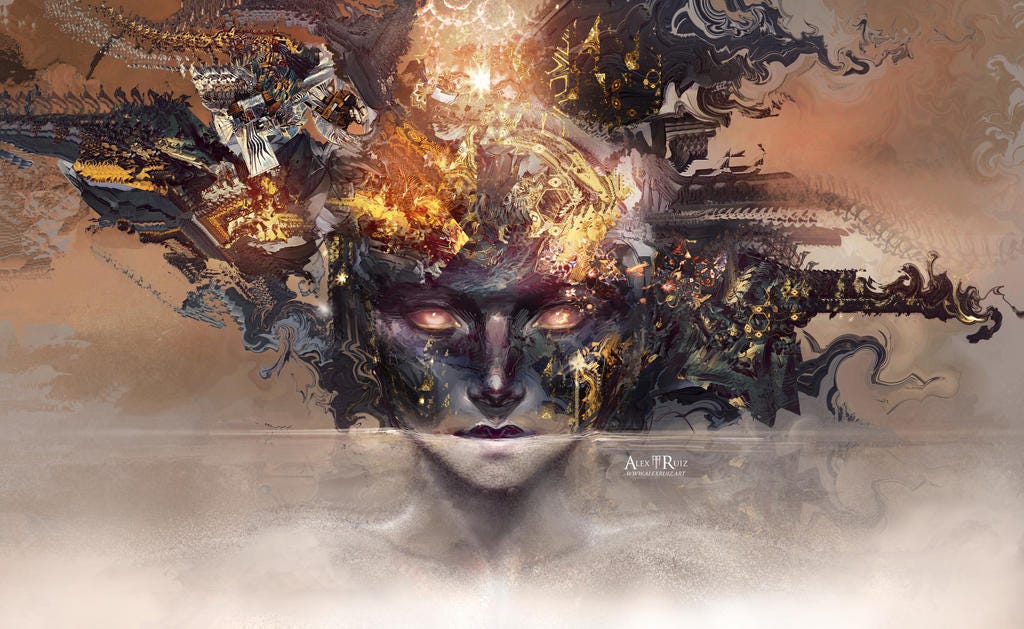
“We don't see the world as it is, we see it as we are”
―Anaïs Nin
I was fifteen years old when my mother was diagnosed as bipolar. My father had moved to another state, and my sister was at college, leaving just the two of us in our household. Our relationship was strained from the aftermath of her finding God around the same time that I came out of the closet. Each of us sought something to hold onto as we could not steady ourselves.
The neighbor next door was a Social Worker who mentioned to my mother one day that she should have her therapist look into whether or not she fit the criteria for being bipolar. The diagnosis came as a relief for a woman who had been searching for so long for an answer to why she was the way she was. Others wondered if this was just another convenient excuse to overlook some of the pain of the past.
To explain my mother’s condition, the neighbor asked that I have my mother write me a note for school that was longer than a paragraph. Later that day, I watched the woman I loved cross out every fourth word, trying desperately to write something coherent while waging a war of internal cross-wiring.
As my neighbor said, “That paragraph is a depiction of her brain.”
From that point forward, I tried to remember that even in my most frustrated moments, all my mother was trying to do was the equivalent of writing a sentence in a letter that her brain wouldn’t allow her to.
My best friend’s favorite story to tell about my mother occurred on a ninety-eight-degree Summer evening in my late twenties. I had decided to take my mother to dinner, and my best friend tagged along.
At that time, I visited my mother weekly to take her shopping and run errands. It is said that all mothers worry, but my mother’s mental illness made it so that her consistent state was anxiety and worry about almost everything. Her concerns ran from not having enough food or money to politics to not being able to get rides to all of her appointments or random fears over her children’s livelihood.
Each week, I did my best to calmly counteract every one of her fears and set her up with enough resources so that she could make it through until I came back a week later.
On this particular evening, her anxiety was around the fact that she was almost out of Half and Half (a strange addiction that I debated submitting to that TV show to receive the payout I believed that I deserved for all I put up with).
As usual, I created a plan of attack that would allow us to make it to dinner on time and hit one of the five grocery stores on the way home so that my mother would not be without her prized possession. The plan was discussed and agreed to multiple times, as was customary.
We stopped briefly at a gas station on the way to the restaurant, where my mother walked out with a bottle of Half and Half in her hands. I will never forget the look my best friend gave me through the rearview mirror from the backseat.
No matter how many times we agreed to stop after dinner, nothing could counteract my mother’s fear that every grocery store would either be out of what she needed or randomly close early as if we all forgot a federal holiday that had just been rolled out nationwide.
We were late for dinner because we had to return to her apartment to put the Half and Half in the fridge. She had offered to hold it throughout dinner, but at that point in my life, I would rather be late than have to explain to a waiter why my mother was holding a bottle of dairy in her arm like a newborn baby at a restaurant.
Although my best friend and I laugh about it now, that moment at the gas station underlines the climate in which I was born.
Growing up, the greatest threat to our household, even more than the chaos inside, was the constant cloud of what could be coming around the corner. We had batteries, flashlights, and candles ready in case we lost power. Even after grocery shopping, the fridge was viewed from the perspective of all the food we didn’t have. For a single-income family of four, we had reason to feel scarcity, but no matter how much we had, there was always the threat that something in the future could take it from us.
But even with all of the prognosticating and catastrophizing, in the subconscious hope of gaining some semblance of control over what was to come, our house was foreclosed, and we started the long road of losing relatives we loved all of a sudden.
No matter how much you plan, the things that are out of your control will come to pass.
It was easy to laugh at the eccentricities that came along with my mother’s personality. It was even easier to judge the addictions and choices made to help her self-soothe. But in her absence, one thing has consistently struck me:
For a woman who was wired into constant uncertainty, we will never know how hard she worked to be as stable as she was so that she could still be our mother.
There is a grace that comes with a new perspective. I wish I could have reacted less in the moments when my mother’s anxiety and mental illness shone through. Everything in her was wired to worry, and no matter how exhausting it was to love, I can only imagine how much more exhausting it was to live in that state.
I found my grief for her passing the strongest around the election. She always taught my sister and me the importance of voting. She watched the news every day and worried, not just about our country but about people she would never meet and how they would be impacted by the decisions being made by those in power.
I cried in the voting booth when I voted, knowing that this was the first election she would not vote in. Voting gave her purpose even in the moments when she questioned whether to go on.
The past few weeks have been interesting for me to navigate. I have friends and loved ones who are terrified of what is to come. Others close to me feel reinforced in their safety and purpose due to recent results. And I sit in a place where I lose myself if I choose to look too far outside of myself or at anything that could come in the future.
But the difference is that I am now lucky enough to get to choose. Years of therapy and counteracting the effects that trauma left on my nervous system have made it so that my baseline is finally one of stability.
I used to look at the world from the perspective of all the horrors that lay in wait around the corner, believing that I would be safer on the day they finally arrived. If I could run every scenario, imagine everything that could go wrong, and tell myself all the ways I wasn’t enough, I would somehow be unaffected when the challenging moments came. But now I know that all I am doing when I live too far in the fear of what could happen in the future is robbing myself of all there is in the current moment.
When I look back on those I miss most, especially my mother, my one wish is that we could have been more present in every moment we had together. But unfortunately, we weren’t wired at that time to be able to.
My goal is presence. When I get too far ahead of myself, I try to remember that it is a Tuesday in November, and the sun is shining.
I have been through enough to know how little I have control over, and I don’t want to exhaust myself for essential moments that may come by worrying about all the possibilities of how they will arrive.
Only some people are awarded the luxury of this perspective. I know all too well that the world, especially now, is scary for those whose internal worlds reflect the same feeling.
No matter how you are wired, there is little to be sure of in this life. We know we were born, we know we will die, and all that is in between feels like a crap shoot.
It is easy to look back at the past, at “better times,” and wish we could jump back in time. But for many of us, our anxiety and uncertainty were even higher back then because those were the lenses we viewed the world through.
All we have is this moment. There is no way to tell what the future holds or adequately prepare. No feelings are forever. All we can do is take our next best step and trust that when the big moments come, we will navigate them as needed.
I spent a lot of time judging my mother for her uncertainty, and now I look back with appreciation for how well she navigated the hand she was dealt. She taught me more through her instability than in the moments when she felt most grounded.
I don't know what my future holds, but knowing that I am made from her makes me feel more confident that I can figure it out, no matter what comes my way.
With Love,
Clayton
Beautiful snapshot and tribute to your mother. I laughed at the comment about you wanting to message My Strange Addiction about the half and half. And I almost cried in other moments, like this one: "For a woman who was wired into constant uncertainty, we will never know how hard she worked to be as stable as she was so that she could still be our mother."
🖤